
Grind it, pull it or leave it
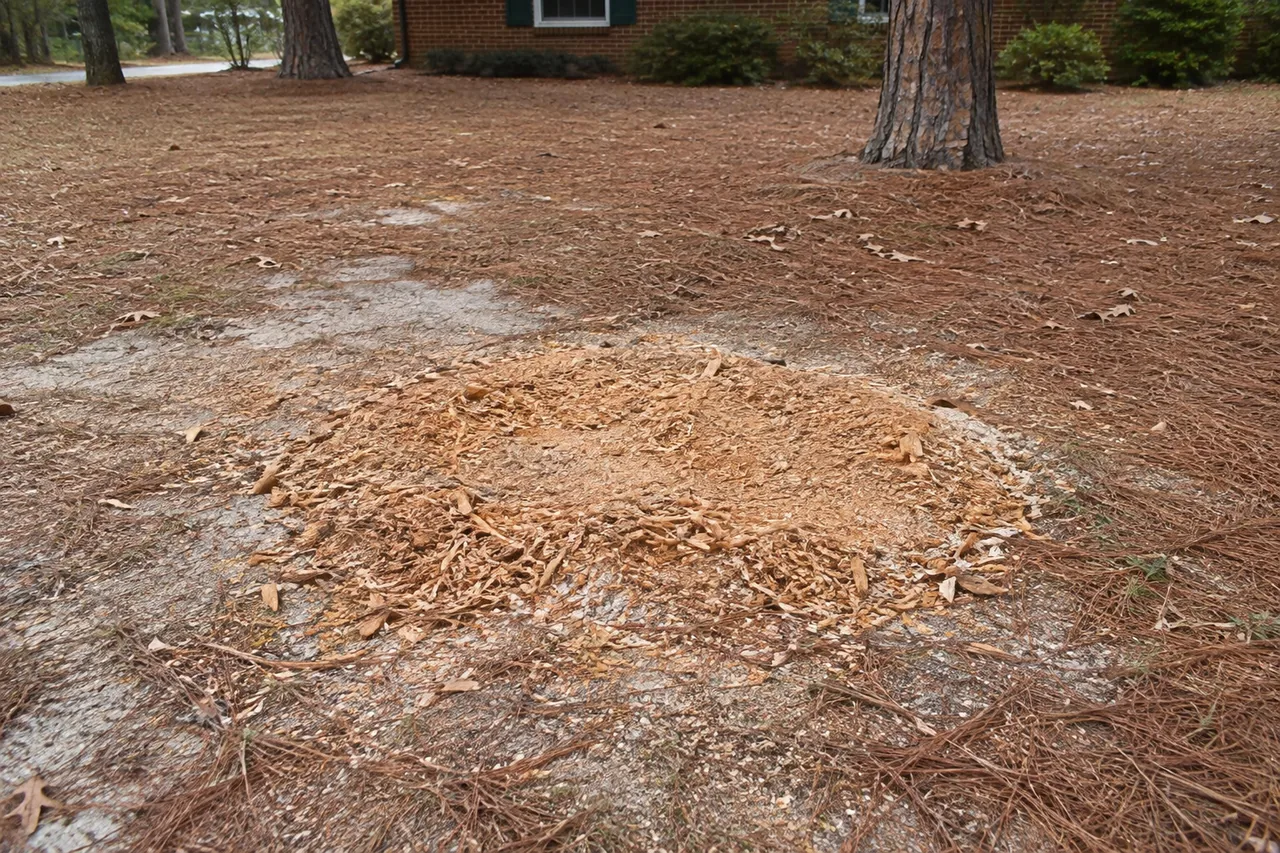
Grinding uses a spinning wheel fitted with teeth to chew the stump and the top of its root flare to chips beneath the grass line. What's left of the root system remains underground and slowly rots. It's the usual choice for lawns, beds, paths and the space along a fence.
Pulling lifts the whole stump and its main roots, usually with an excavator, and leaves a hole to fill and pack. It's the better choice where something will be built: a slab, a footing, a patio, a driveway, an addition. Rotting roots under new construction can leave soft spots.
Leaving it is the cheapest choice up front. A low-cut stump in a wooded corner may be fine where it is, though it can be a mower hazard in a lawn.
A pine has an extra wrinkle. The U.S. Forest Service's profile of longleaf pine describes a taproot 8 to 12 feet long on good sites, along with wide side roots (checked Nov 9, 2026). Grinding takes away what you see and the top of the root flare, not that taproot. For a lawn it doesn't matter; for a footing it might, which is where pulling or an engineer's advice comes in.
The NC 811 notice comes first
Grinding a stump below the surface moves earth, and North Carolina's definition of excavation in G.S. 87-117 covers moving or removing earth with manual or mechanized equipment, and G.S. 87-122 requires notice "no less than three full working days" before the work starts (checked Nov 9, 2026). The steps:
- Call 811 or 1-800-632-4949 at least three full working days ahead. NC 811 says utilities then mark their public lines for free (checked Nov 9, 2026).
- Mark the area in white if the locators can't tell from the ticket where the work is. The statute calls for white paint, white flags or white stakes.
- Wait for the marks, and keep them in place until the job is done.
- Dig carefully near a mark. The law's tolerance zone is 24 inches on either side of a marked line, plus half the line's width where it's known.
- Watch the clock. The notice expires 28 calendar days after the work start date. A stump that waits longer needs a new ticket.
Who files the ticket is something to settle with the contractor before the visit. Many crews file their own. Either way, ask to see the ticket number.
Lines nobody will mark
NC 811's own FAQ says only publicly owned lines are marked by their owners (checked Nov 9, 2026). On a Moore County lot, that leaves a list of things the homeowner has to point out:
- The septic tank, pipes and drainfield. The state's 811 law leaves certain septic systems out of its definition of underground facilities.
- Irrigation lines and heads, which the same law also leaves out.
- Water lines from a private well to the house or outbuildings.
- Power or data run underground to a detached garage, shed, pool equipment, gate or landscape lights.
- Propane lines from a buried or above-ground tank to the house.
Flag what you know, show the crew where the lines run, and if a stump sits on or next to the septic field, ask whether the job should be done another way.
Chips, sand and a sinking spot
A ground pine stump leaves a mound of chips mixed with whatever is around it, and on a Sandhills lot that's usually sand. The USDA's descriptions of the Candor and Lakeland soils, two sandy series found in the Carolina Sandhills, describe sand 40 to more than 80 inches deep that drains quickly (checked Nov 9, 2026).
What to do with them:
- For grass: rake most chips out of the hole, fill with soil, and seed or sod over it. Grass tends to struggle in a pocket of raw wood chips.
- For a bed: spread the chips around shrubs as mulch, or mix them with pine straw.
- To haul them: agree on it in writing. In Southern Pines, chips aren't something the town lists for curbside pickup; ask the contractor to take them.
Expect the spot to settle as roots underneath decay. Plan to top it off with soil later.
Stumps near the street
A stump between the pavement and your lawn may be on public right-of-way. Southern Pines requires a Tree Removal Permit before a right-of-way tree is removed, and Pinehurst routes right-of-way trees through its Public Services Department at 910-295-5021 (both checked Nov 9, 2026). If the town removed the tree, ask whether it plans to grind the stump before hiring anyone.
If the tree is still standing
It's often simpler and cheaper to have the same crew take the tree down and grind the stump on one visit, since the grinder only travels once. HomeGuide's figures put grinding at $120 to $400 for the first stump and $30 to $60 for each extra one (checked Nov 9, 2026), so a yard with several stumps costs far less per stump than one stump alone. See tree removal.
What stump grinding costs
| Source | What it says |
|---|---|
| Thumbtack stump guide, updated Oct 23, 2026 (checked Nov 9, 2026) | Grinding about $160 to $250; stump removal $207 to $579 on average, with a low end around $102 and a high end around $1,144 |
| HomeGuide (checked Nov 9, 2026) | Grinding $120 to $400 for the first stump, $30 to $60 for each additional stump |
| HomeAdvisor, updated April 16, 2024 (checked Nov 9, 2026) | Grinding $100 to $400; removing the full stump and roots $200 to $550 |
The size of the stump at ground level, how many there are, whether the machine fits through the gate, how deep you want it ground, and whether cleanup and fill are included all move the price. Measure the widest part of each stump at ground level before you call. None of these numbers is a Moore County quote; the contractor's written price is.
Grinding mistakes to avoid
- No 811 ticket. It's required by state law, and a cut line can be dangerous and expensive.
- Forgetting the private lines. Septic, irrigation and well lines won't be marked by anyone but you.
- No depth agreed. Write down how deep the stump will be ground and whether surface roots running across the lawn are included.
- Chips left in the hole under new sod. The patch usually struggles and then sinks.
- Grinding where you'll build. Under a slab or footing, pulling is the safer choice.
When grinding isn't the answer
For a whole lot full of stumps after clearing, an excavator or a large track grinder is a different job, closer to land clearing. If a stump is sprouting from a tree you'd rather keep growing, that's not a grinding question at all.
Stump questions
How deep does a grinder go?
It depends on the machine and what you ask for. Tell the contractor what will go on the spot, lawn, bed, fence post or walkway, and get the depth written into the price.
Do I need to call 811 for one small stump?
Yes. A grinder wheel working below the grass line can reach a shallow line, so file the ticket, or confirm the contractor has.
Is grinding several stumps cheaper per stump?
Usually. HomeGuide's pricing charges far less for each additional stump than for the first.
Will the roots grow back?
Some kinds of trees send up sprouts from the stump and roots after cutting. Whether yours will depends on the species, so raise it with the contractor.
A stump grinding request sent here goes to one independent contractor who works in Moore County. This site doesn't grind stumps.
- N.C. General Statutes 87-117 and 87-122; NC 811 FAQ. Checked Nov 9, 2026.
- USDA Forest Service, Fire Effects Information System, Pinus palustris (Carey, 1992). USDA NRCS Official Series Descriptions, Candor and Lakeland soils. Checked Nov 9, 2026.
- Town of Southern Pines, Trees page and Yard Debris page; Village of Pinehurst, Planning page. Checked Nov 9, 2026.
- Thumbtack, 2026 Stump Removal Cost Guide (updated October 23, 2026); HomeGuide, tree removal cost guide; HomeAdvisor, tree removal cost guide (updated April 16, 2024). National figures, checked Nov 9, 2026.