
Yard trees at a glance
| Tree | Size (NC State Extension) | What to watch |
|---|---|---|
| Longleaf pine | 60–120 ft tall | Lightning, beetles after injury; snaps less than loblolly in hurricanes but can lean or blow over |
| Loblolly pine | 60–90 ft tall | Fastest-growing pine; "susceptible to wind damage"; southern pine and engraver beetles |
| Turkey oak | 30–40 ft tall | "Highly susceptible to oak wilt" |
| Water oak | 50–80 ft tall | "May only live 30 to 50 years"; weaker wood; breaks in wind and ice |
| Willow oak | 40–75 ft, can reach 100 | Long-lived and fast-growing; tagged as wind-damage prone |
| Live oak | 40–80 ft tall, 40–100 ft wide | "Quite wind-resistant"; native to the coast |
| Dogwood | 15–25 ft tall | May need afternoon shade in the Piedmont and on the coast; mildew, borers |
| Sweetgum | 60–100 ft tall | "Shallow root system"; gumballs |
| Bradford pear | Up to 50 ft tall | Splits in wind and ice; invasive in North Carolina |
NC State Extension Plant Toolbox profiles, checked Nov 9, 2026.
The ground under them
Candor and Lakeland are two of the sandy soil series the USDA describes for the Carolina Sandhills, the region Southern Pines and Pinehurst sit in. The USDA's official descriptions put Candor's sandy layers at 40 to 78 inches thick and call it somewhat excessively drained, with rapid permeability up top. Lakeland is sand more than 80 inches deep and excessively drained. Both list turkey oak, blackjack oak and post oak growing with longleaf pine where the land is wooded (checked Nov 9, 2026).
Deep, dry sand shapes how yard trees live. Longleaf and turkey oak both grow deep taproots, according to NC State Extension, and its bark beetle publication notes that drought is one of the stresses that draws engraver beetles to pines (checked Nov 9, 2026).
Longleaf pine
Longleaf is the tree of the Sandhills. NC State Extension describes a pine 60 to 120 feet tall with an open, irregular crown of short, stout branches, which spends roughly its first five years in a "grass" stage before it shoots up. The U.S. Forest Service says mature trees reach 100 to 120 feet and grow a taproot 8 to 12 feet long on good sites (both checked Nov 9, 2026).
It stands up to wind better than other pines. Research from Hurricane Katrina summarized by the N.C. Forest Service found 8.9 percent of longleaf with snapped trunks, against 75.9 percent of loblolly, though longleaf had the most trees that leaned or blew over (checked Nov 9, 2026). Pinehurst's development ordinance names longleaf among the mature specimen trees that new building sites should be designed to keep, and the U.S. Fish and Wildlife Service recommends that Clear Zone projects in Moore County keep all old-growth longleaf (both checked Nov 9, 2026). The red-cockaded woodpecker nests in these pines; see longleaf and tall pines.
Loblolly pine
Loblolly is the other big pine in local yards. NC State Extension says it "has the most rapid growth rate of all pines," reaching 60 to 90 feet, and lists it as "susceptible to wind damage," with southern pine beetle and the pine engraver as its main pests. The same profile recommends planting it away from the house and calls planting it among homes in subdivisions "not recommended due to its fire hazard" (checked Nov 9, 2026). The Katrina research above found three of every four loblollies with snapped trunks.
Turkey oak and the scrub oaks
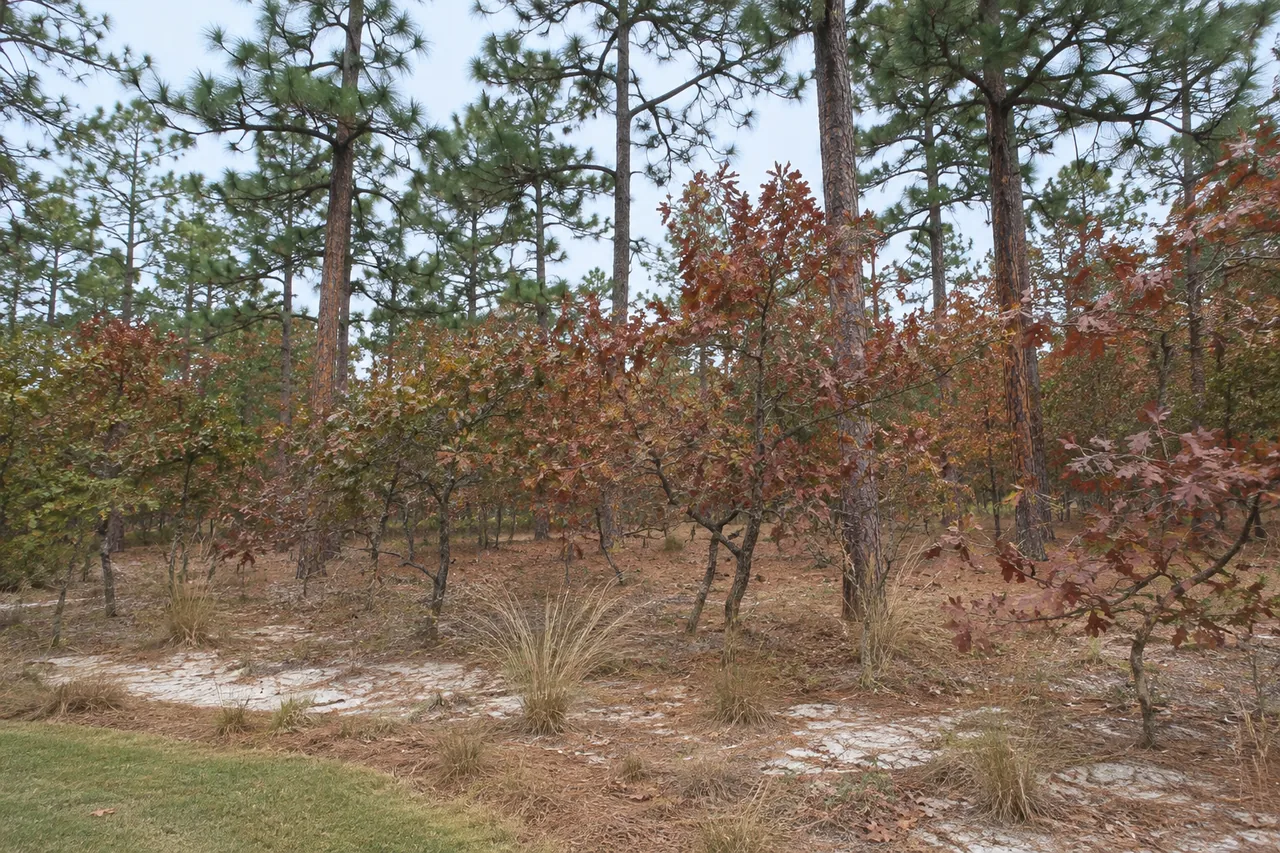
Turkey oak is the scrubby, crooked oak under the longleaf. Its name comes from its deeply lobed leaf, which looks like a turkey's foot, and NC State Extension says it grows 30 to 40 feet tall in dry sandy soils "where few other oaks will grow," helped by a deep taproot. Its fall color runs red to red-orange. The profile also says it is "highly susceptible to oak wilt" (checked Nov 9, 2026). Blackjack, bluejack and post oak grow with it on the same soils, according to the USDA soil descriptions. These oaks stay well below the pines above them, but a dead one leaning over a fence or drive is still worth taking down.
Water oak and willow oak
Water oak is the shade tree to watch. NC State Extension says it grows 50 to 80 feet tall and 50 to 70 feet wide, "may only live 30 to 50 years," is "regarded as weaker wooded in comparison to most oaks," and "is a risk for breakage from wind or ice." It even suggests red oak, white oak or swamp white oak as stronger alternatives (checked Nov 9, 2026). A big water oak planted when a neighborhood was new may now be at the end of its expected life.
Willow oak is longer-lived and fast-growing, typically 40 to 75 feet and sometimes 100. NC State tags it as prone to wind damage but says it generally resists pests and diseases better than most oaks (checked Nov 9, 2026).
Live oak
If a live oak shades your yard, here is what NC State Extension says about it: a broad tree 40 to 80 feet tall that can spread 40 to 100 feet, native to the coastal plain and suited to hardiness zones 8a through 10b. It calls live oak "quite wind-resistant" and notes that root rot and oak wilt can be problems (checked Nov 9, 2026). With a spread that can reach 100 feet, a live oak's limbs can stretch over a roof or driveway, which usually calls for clearance pruning rather than removal.
Dogwood
Flowering dogwood is a small understory tree, 15 to 25 feet tall. NC State Extension notes that in the Piedmont and on the coast it may need more shade, especially in the afternoon, and that it can be challenging to grow in urban settings; spot anthracnose, powdery mildew and dogwood borers are among its problems (checked Nov 9, 2026). Pinehurst's ordinance names dogwood alongside longleaf, American holly and southern magnolia as a mature specimen tree. A dogwood is too small to threaten most houses, but a dead one is still worth clearing out of a bed.
Sweetgum
NC State Extension says sweetgum can reach 60 to 100 feet and "has a shallow root system," and its spiky gumballs are "a litter problem in lawn and patio areas," falling from about December through April (checked Nov 9, 2026). If the soil around a tall sweetgum's base heaves or cracks after a storm, the N.C. Forest Service's storm guide treats lifting roots as a reason for removal (checked Nov 9, 2026).
Bradford pear
NC State Extension doesn't mince words: Callery pear has "weak crotches that break with age, wind and ice," the Bradford variety "develops tight crotches that are likely to be split in half by heavy wind and rainstorms," and the species is "an invasive species in North Carolina." It suggests native alternatives such as eastern redbud, flowering dogwood, serviceberry and American plum (checked Nov 9, 2026).
Storms these trees have been through
- Hurricane Fran, September 1996. Of the 24 North Carolina deaths the State Climate Office ties to Fran, 12 were caused by falling trees, and 1.7 million customers lost electricity (checked Nov 9, 2026).
- Winter storm, January 24–25, 2000. About 260,000 people lost power statewide, "mostly in the Sandhills," the same office reports (checked Nov 9, 2026).
- Ice storm, December 4–5, 2002. The State Climate Office describes large trees and power lines downed by ice across central North Carolina and nearly one million people without power, some for close to a week (checked Nov 9, 2026).
- Ice, January 22–23, 2016. A quarter inch of ice extended into the Sandhills (State Climate Office, checked Nov 9, 2026).
- Hurricane Florence, September 2018. A 44-knot gust at the Moore County Airport, 9.18 inches of rain near Aberdeen, and evacuations from floodwater in southeastern Moore County (NWS Raleigh, checked Nov 9, 2026).
Lightning and pines
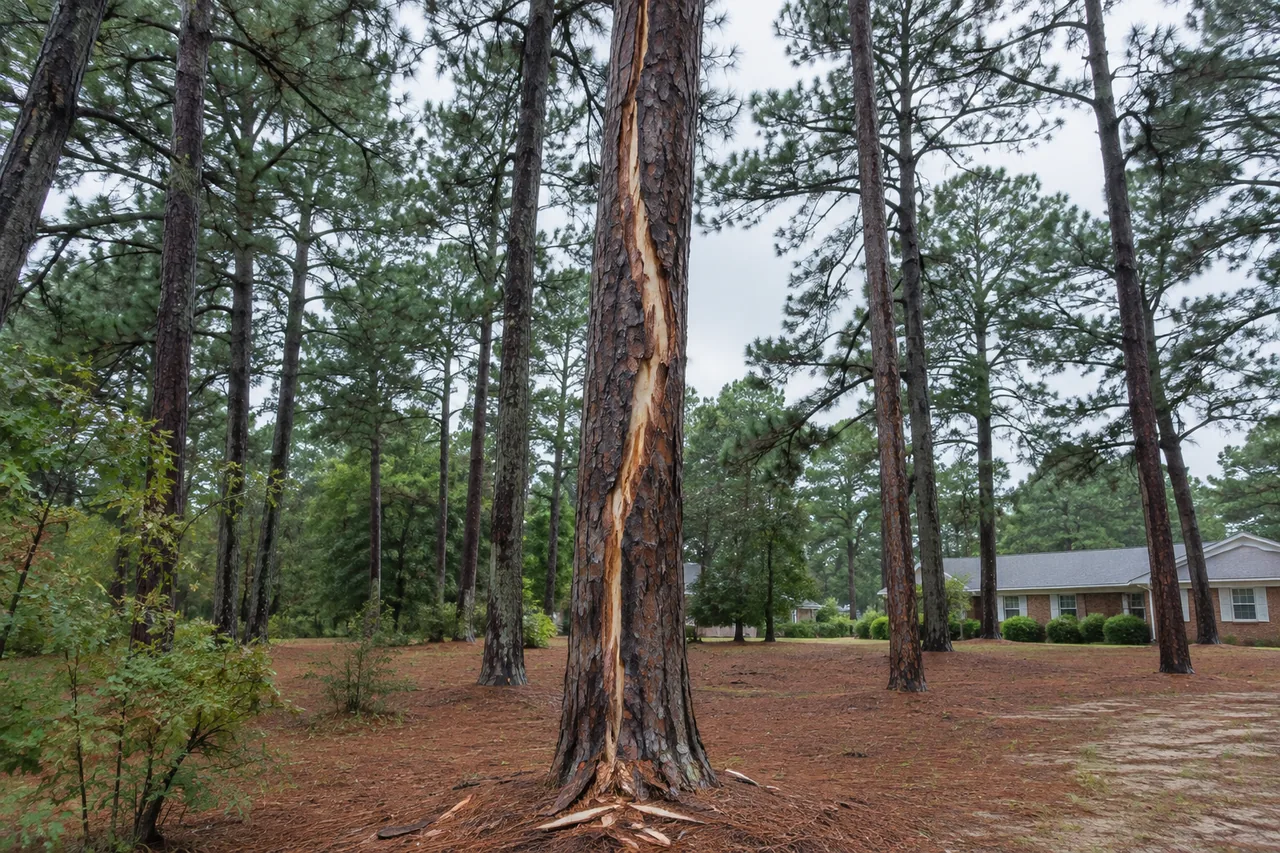
Lightning has always been part of life in a longleaf forest. The U.S. Forest Service's longleaf profile says lightning historically started the frequent fires the forest depends on, and that the resin-rich trunks of older pines act as lightning receptors (checked Nov 9, 2026). In a yard, a strike is bad news for the tree: NC State Extension says engraver beetles are drawn to lightning-struck pines, and Mississippi State University Extension advises felling and removing struck pines right after storms so beetle spots don't start in them (both checked Nov 9, 2026).
Choosing what to plant next
If a tree comes down, think about what replaces it and where. NC State Extension's loblolly profile advises planting it away from homes because of fire hazard, and its Bradford pear profile points to native flowering trees instead. Longleaf is slow to start but holds up better in wind. Keep tall trees well back from the house, out from under power lines, and clear of the septic field. Pinehurst's development ordinance has an appendix listing trees suited to Sandhills conditions, and Southern Pines' Parks & Grounds staff can answer questions about street trees.
Questions about local trees
How can I tell longleaf from loblolly?
NC State Extension describes longleaf's crown as open and irregular, with short, stout branches, and its Plant Toolbox has photos of both species. The contractor can also confirm on the visit.
Should every water oak near the house come down?
No, but an old one deserves a closer look. NC State Extension says water oaks may live only 30 to 50 years and break more easily than most oaks in wind and ice.
Can I remove a Bradford pear without a permit?
On your own lot in Southern Pines or Pinehurst, the towns' pages list no permit for that, outside the right-of-way and Pinehurst's historic district front yards. NC State Extension lists the tree as invasive.
Are turkey oaks worth keeping?
NC State Extension notes turkey oak's red fall color and acorns that feed wildlife, and lists it as usable as a shade, street or understory tree. Dead or leaning ones near a structure are the ones to remove.
Questions about a particular tree go to one independent contractor who works in Moore County when you send a request. This site doesn't inspect or remove trees.
- NC State Extension Plant Toolbox: Pinus palustris, Pinus taeda, Quercus laevis, Quercus nigra, Quercus phellos, Quercus virginiana, Cornus florida, Liquidambar styraciflua, Pyrus calleryana. NC State Extension, Pine Bark Beetles (August 4, 2022). Checked Nov 9, 2026.
- USDA NRCS Official Series Descriptions, Candor and Lakeland. USDA Forest Service, Fire Effects Information System, Pinus palustris (Carey, 1992). N.C. Forest Service, SRN-006 (July 14, 2017). Checked Nov 9, 2026.
- State Climate Office of North Carolina: Fran article (2016); winter storm records for January 24–25, 2000 and December 4–5, 2002; "Rapid Reaction" (January 2026). NWS Raleigh, Florence post-tropical cyclone report (2018). Checked Nov 9, 2026.
- Pinehurst Development Ordinance § 9.14.6; U.S. Fish and Wildlife Service, Moore County Clear Zone letter; Mississippi State University Extension, P2448; N.C. Forest Service, Storm-Damaged Tree Assessment Best Management Practices. Checked Nov 9, 2026.