
Signs a tree may fail
The N.C. Forest Service's "Storm-Damaged Tree Assessment" guide was written for cities sorting trees after storms, but its lines work for any homeowner looking up at a tree near the house (checked Nov 9, 2026):
- Half the crown gone. The guide's blanket recommendation is to remove a tree that has lost 50 percent or more of its live crown.
- Cracks into the heartwood, especially along with decay or a cavity.
- A split between two main stems, which the guide calls structurally compromised.
- Lifting roots. Soil cracking or mounding on one side of the trunk means the root plate is moving.
- A lean of about 30 degrees or more, which calls for a close inspection.
- Hangers, broken limbs caught in the crown, which can drop without warning.
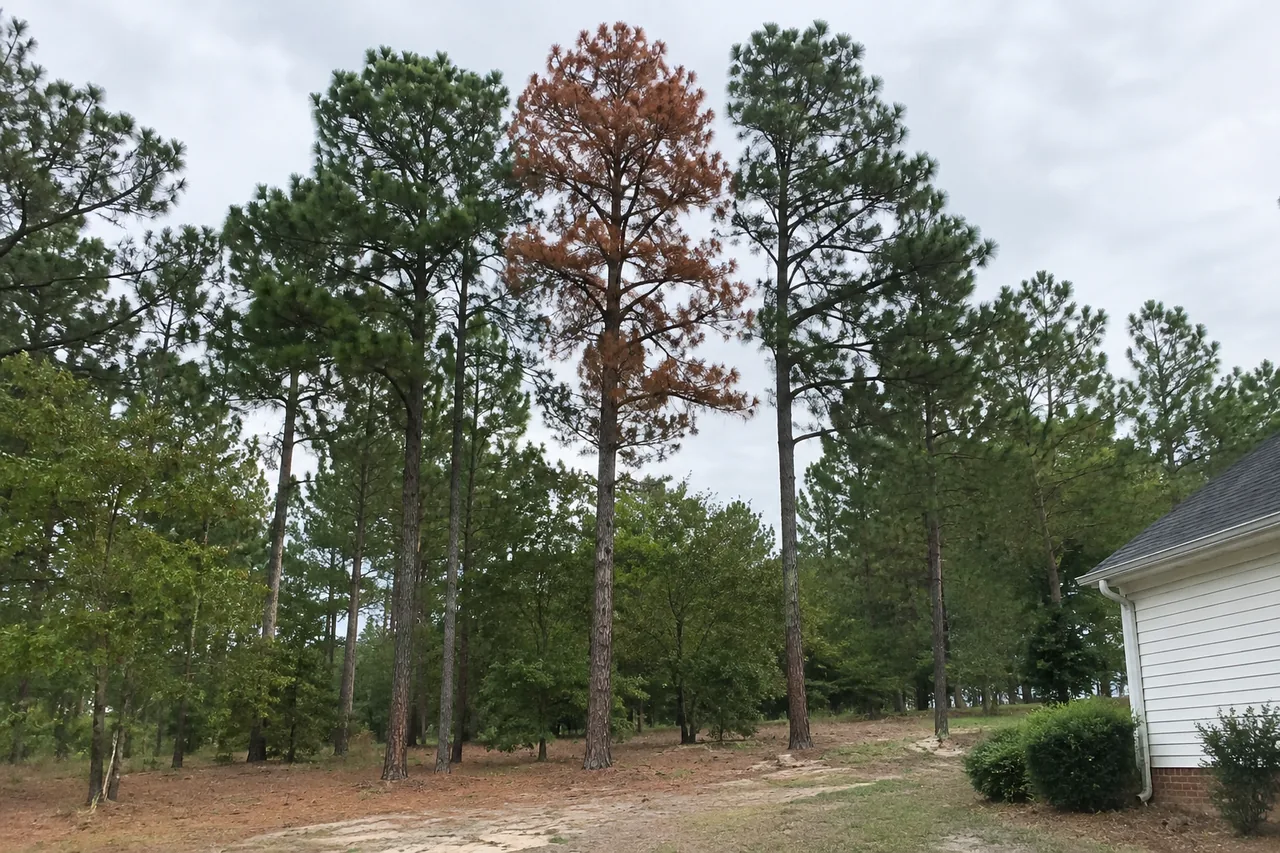
Two more signs from NC State Extension's bark beetle publication apply to pines in particular: needles fading from green toward yellow and red, and bark loosening and falling away where beetles have eaten the layer beneath it (checked Nov 9, 2026).
When a lean is dangerous
Plenty of trees grow at an angle toward the light and stand that way for decades. The lean that matters is one that's new or getting worse. Look for a freshly bent trunk after a storm, a raised mound of soil on the side away from the lean, torn roots, or cracks in the ground. Any of those means the anchor is failing.
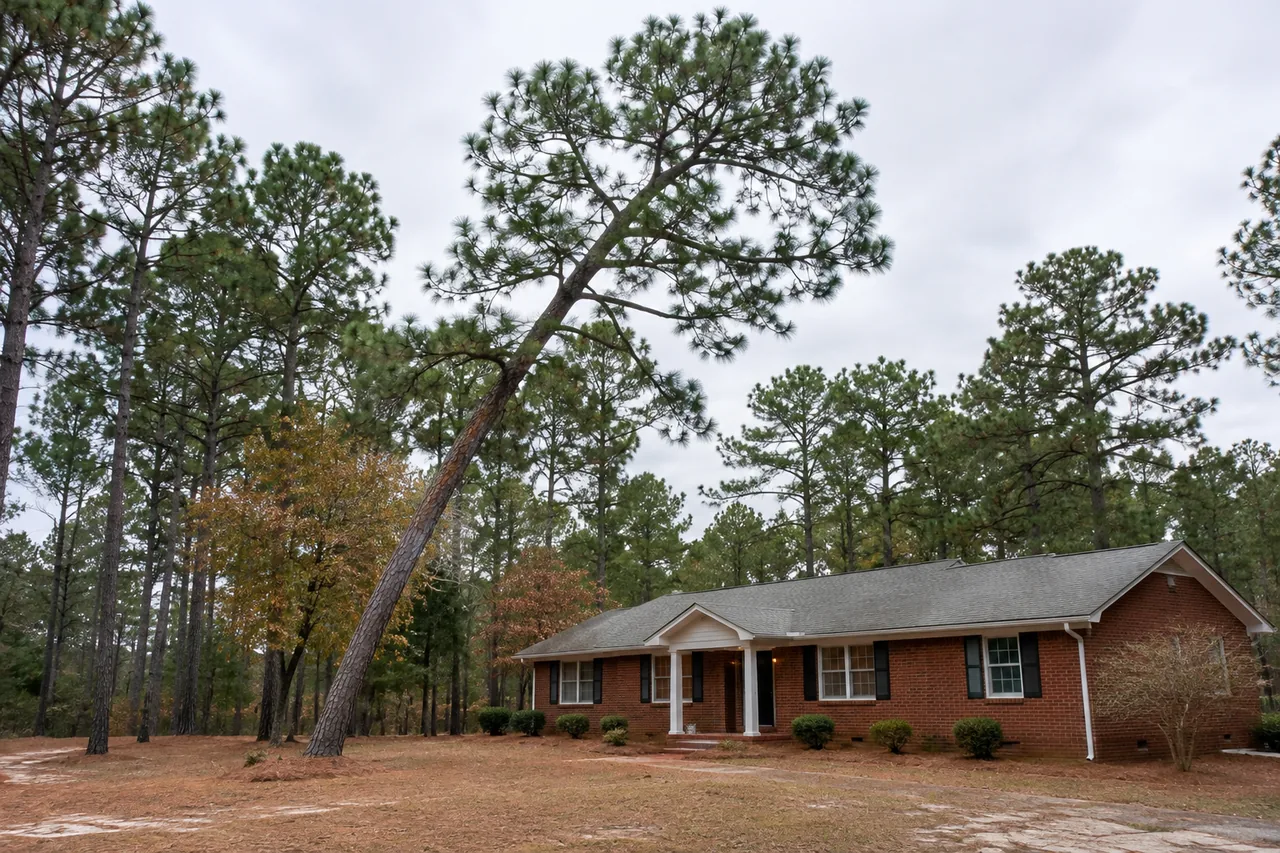
For pines, the Forest Service's bulletin on storm-damaged southern pines is blunt: in mature trees, "expect mortality of trees with visible root damage, especially if associated with lean greater than 45 degrees," and heavily damaged trees "are best removed as soon as possible" (checked Nov 9, 2026). NC State Extension's plant profile lists loblolly as susceptible to wind damage and the fastest-growing of the pines (checked Nov 9, 2026), which is how a pine planted as a screen ends up towering over a roofline.
Pines that turn yellow, then red
A pine dying from bark beetles changes color in stages. NC State Extension's "Pine Bark Beetles" publication (August 4, 2022; checked Nov 9, 2026) describes needles fading from green to light green to yellow and then red, and lists the other signs:
- Pitch tubes: small, popcorn-like blobs of resin on the bark where the tree tried to push beetles out.
- Black turpentine beetle tubes: larger ones, low on the trunk, within about the bottom 15 feet.
- Galleries under the bark: S-shaped tunnels for southern pine beetle, I-, X-, Y- or H-shaped ones for Ips engravers.
- Loose, falling bark in heavy infestations.
The Sandhills have their own history here. A 2016 N.C. Forest Service note reported that Ips engraver beetle activity rose in 2015, "causing scattered damage especially in the Sandhills region of the state" (checked Nov 9, 2026). The Forest Service's 2025 forest health summary found no southern pine beetle spots in its aerial surveys that year, but reported Ips and black turpentine beetles still killing stressed pines in the Coastal Plain and Piedmont, from a few trees up to about 10 acres at a time (checked Nov 9, 2026).
NC State Extension says Ips engravers are drawn to pines stressed by drought, storm or fire damage and lightning strikes. The publication describes beetle-killed pines fading to red and says these red-topped trees are often the first sign anyone notices, which means the tree that caught your eye is already dead. The longer a dead tree stands, the further its wood decays.
Lightning scars
The U.S. Forest Service's longleaf pine profile notes that the resin-rich trunks of older pines act as lightning receptors (checked Nov 9, 2026). A struck pine may stay green for a while, but it's weakened in exactly the way beetles look for. NC State Extension lists lightning strikes among the stresses that set pines up for Ips engraver attack, and Mississippi State University Extension's bark beetle publication says southern pine beetles can start a spot at a lightning-struck tree. For that beetle, it advises felling lightning-struck pines and removing them right after storms (both checked Nov 9, 2026).
Water oaks past their prime
If an older water oak shades your house, know that NC State Extension describes the species as relatively short-lived, "may only live 30 to 50 years," with wood "regarded as weaker wooded in comparison to most oaks." The same profile says water oak "is a risk for breakage from wind or ice" (checked Nov 9, 2026). A big water oak over a house that's dropping limbs, has bark falling away at the base, or shows a hollow when tapped is worth having looked at before the next ice storm.
When the hazard is next door
NC State Extension's paper on tree fall liability explains that a neighbor generally has to show negligence to hold a tree's owner responsible when it falls across the line. The things that make a failure foreseeable include a tree that is dead or visibly dying, one leaning prominently toward the adjacent property, limbs reaching far over the line, and an owner cutting a large anchoring root (checked Nov 9, 2026). If a neighbor's tree worries you, tell them in writing and keep a copy. If it falls on your house, the claim still starts with your own insurance company, as the storm guide explains.
Rules for taking down a hazard tree
A dead or leaning tree on your own lot in Southern Pines or Pinehurst generally doesn't need a town removal permit, by the towns' own pages. The exceptions still apply to hazard trees: a tree in the right-of-way belongs to the town, a front-yard tree in Pinehurst's historic district may need a certificate of appropriateness, and a pine marked with a white paint band falls under federal red-cockaded woodpecker rules. See the rules guide and longleaf and tall pines.
Mistakes with dead and leaning trees
- Waiting for the next storm. A tree that's already failing is harder, slower and riskier to take down once it's on the roof.
- Assuming a dead tree can be climbed like a live one. Decayed wood and loose bark change how a crew can work; tell the contractor how long the tree has been dead.
- Leaving a lightning-struck pine. Extension advice is to remove struck pines promptly so beetles don't build up in them.
- Treating a red pine as a fix-it-later job. NC State Extension describes beetle-killed pines fading to red, so a red pine near the house is a dead one.
- Digging in the root zone of a leaner. Cutting anchoring roots for a driveway, a fence or a utility line can tip the balance.
Questions about failing trees
My pine went from green to rust in a few weeks. Can it be saved?
If beetles turned it, no. NC State Extension describes pines killed by bark beetles fading from green to yellow to red. The useful question is what's happening to the pines around it: look for pitch tubes and fading needles nearby, and plan to remove the dead one before it becomes brittle.
Is every leaning tree dangerous?
No. A tree that has grown at an angle for years and has solid roots may be fine. A new lean, a heaving root plate or cracks in the soil are the warning signs.
Lightning hit a pine in my yard but it's still green. Should I wait?
Mississippi State Extension's beetle guidance is to fell and remove lightning-struck pines promptly. Have it looked at soon, and watch neighboring pines for pitch tubes.
Who decides whether a tree is a hazard?
You, with advice from whoever looks at it. For a tree in the right-of-way, the town decides. If a neighbor's tree is the problem, document it and keep copies of what you sent them.
Requests sent from this page go to one independent contractor who works in Moore County. This site removes no trees.
- N.C. Forest Service, Storm-Damaged Tree Assessment Best Management Practices; Managing Storm Damage to Southern Yellow Pines (TRB-002, August 2015); Forest Health Note on southern pine beetle (June 2016); 2025 Forest Health Highlights. Checked Nov 9, 2026.
- NC State Extension, Pine Bark Beetles (K. Oten, August 4, 2022); Plant Toolbox, Pinus taeda and Quercus nigra; Tree Fall Liability (R. A. Branan). Checked Nov 9, 2026.
- USDA Forest Service, Fire Effects Information System, Pinus palustris (Carey, 1992). Mississippi State University Extension, Identifying and Controlling the Southern Pine Bark Beetles (P2448). Checked Nov 9, 2026.
- Town of Southern Pines, Trees page; Village of Pinehurst, Buffer Development Standards FAQ. Checked Nov 9, 2026.