
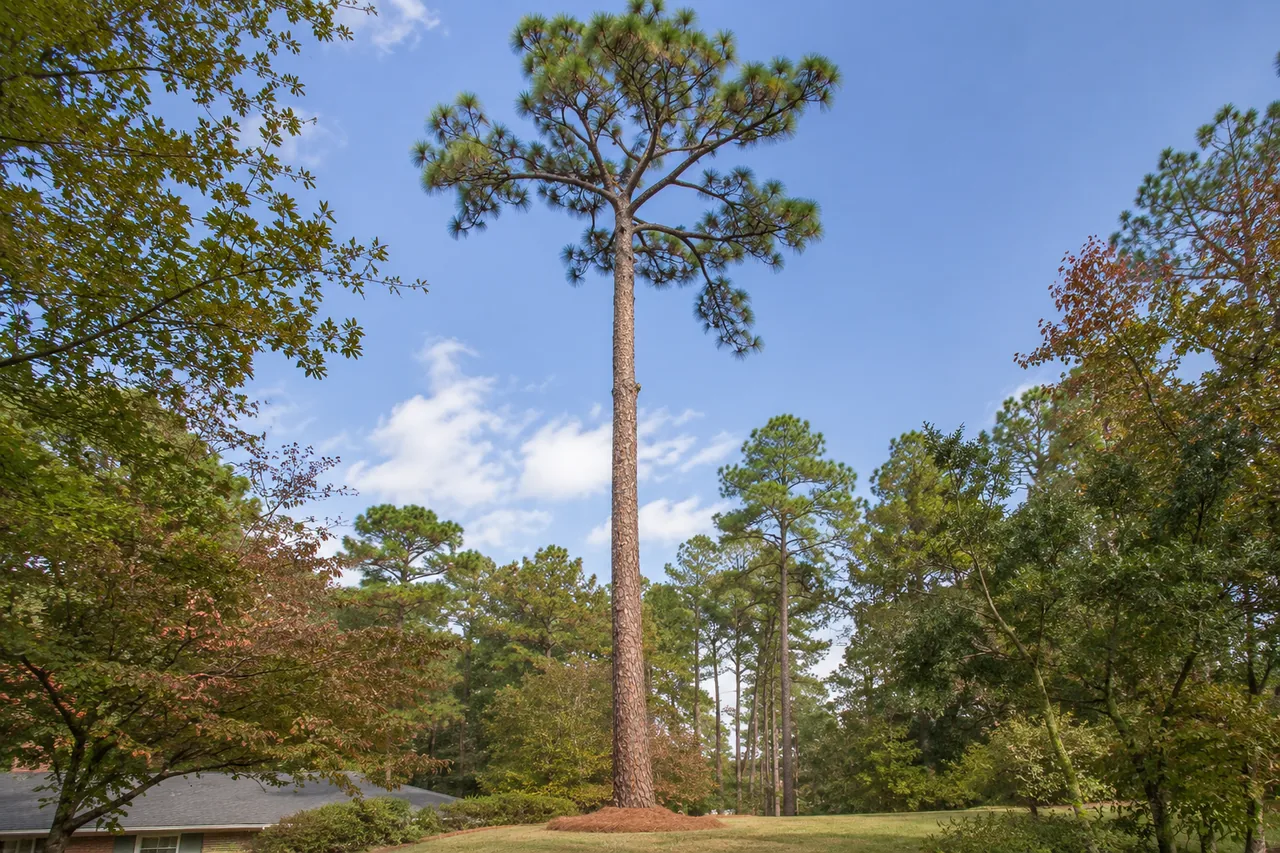
Longleaf and loblolly, side by side
Longleaf and loblolly are the two pines this page deals with, and they behave differently.
| Longleaf pine | Loblolly pine | |
|---|---|---|
| Height (NC State Extension) | 60 to 120 feet | 60 to 90 feet |
| Spread | 30 to 40 feet, open and irregular crown | 20 to 40 feet |
| Growth | Spends about its first five years in a low "grass" stage | "The most rapid growth rate of all pines" |
| Roots | Deep taproot; 8 to 12 feet on good sites, says the U.S. Forest Service | NC State's profile doesn't describe them |
| Wind | "Less susceptible to wind damage than other pines" | "Susceptible to wind damage" |
| Pests | No serious pest problems in landscapes, though bark and engraver beetles can attack | Southern pine beetle and pine engraver |
NC State Extension Plant Toolbox profiles of Pinus palustris and Pinus taeda; USDA Forest Service Fire Effects Information System, Pinus palustris. Checked Nov 9, 2026.
If you're not sure which pine you have, the contractor can tell you on the visit. It matters for more than curiosity: the two species differ in how they handle wind, how fast they grow toward a roofline, and which beetles go after them.
Hurricane wind and ice
The N.C. Forest Service summed up two studies of how pines fared in Hurricane Katrina in a 2017 research note (checked Nov 9, 2026). In one, 7 percent of longleaf died against 26 percent of loblolly. In the other, 75.9 percent of loblolly had snapped trunks, against 38.1 percent of slash pine and 8.9 percent of longleaf.
That's good news about longleaf, with a catch. The same note says longleaf had the highest share of trees that leaned (16.9 percent) or blew over whole (10.2 percent) (checked Nov 9, 2026). A longleaf is less likely to snap, but it can still lean or go over, and a 100-foot pine on its side reaches a long way.
Ice is the other hazard. Pines keep their needles through winter, so they gather ice when hardwoods are bare. The State Climate Office of North Carolina reports that the January 24–25, 2000 winter storm left about 260,000 people without power across the state, mostly in the Sandhills, and that a quarter-inch coating of ice reached into the Sandhills in January 2016 (checked Nov 9, 2026). During Hurricane Florence in 2018, the Moore County Airport measured a 44-knot gust, the National Weather Service in Raleigh reported (checked Nov 9, 2026).
Lightning
The U.S. Forest Service's longleaf profile says lightning historically set the frequent fires the longleaf forest depends on, and that the resin-rich trunks and roots of older trees act as lightning receptors; a smoldering tree can even start a ground fire days or weeks later (checked Nov 9, 2026).
A strike also turns a pine into beetle food. NC State Extension lists lightning among the stresses that draw Ips engraver beetles. Mississippi State University Extension says southern pine beetles can start a spot at a lightning-struck tree, and for that beetle it advises felling and removing struck pines right after storms (both checked Nov 9, 2026). If lightning hits a pine near your house, have it looked at soon even if it's still green.
Bark beetles
NC State Extension's "Pine Bark Beetles" (August 4, 2022) lists the signs: popcorn-like pitch tubes of resin on the bark, needles fading from green to yellow to red, and, for black turpentine beetle, large tubes within the bottom 15 feet of the trunk. It says Ips engravers are drawn to pines stressed by drought, storm or fire damage and lightning, and black turpentine beetles to recently wounded trees (checked Nov 9, 2026).
The Sandhills have seen it before. A 2016 N.C. Forest Service note reported Ips engraver activity rising in 2015, "causing scattered damage especially in the Sandhills region of the state." The Forest Service's 2025 summary found no southern pine beetle spots from the air that year but still reported Ips and black turpentine beetles killing stressed pines, from single trees up to about 10 acres (both checked Nov 9, 2026).
When a pine is coming down near others you're keeping, ask the crew not to scar the keepers' trunks or crush their roots with equipment, since wounds are what draw black turpentine beetles.
Pines, fire and the house
NC State Extension rates both longleaf and loblolly as highly flammable. Its loblolly profile advises against planting it within a home's defensible space and calls planting it among homes in subdivisions "not recommended due to its fire hazard" (checked Nov 9, 2026). That isn't a reason to cut every pine, but it's worth weighing for a loblolly with limbs over the roof or crowding the deck.
If a pine has a white band painted around it
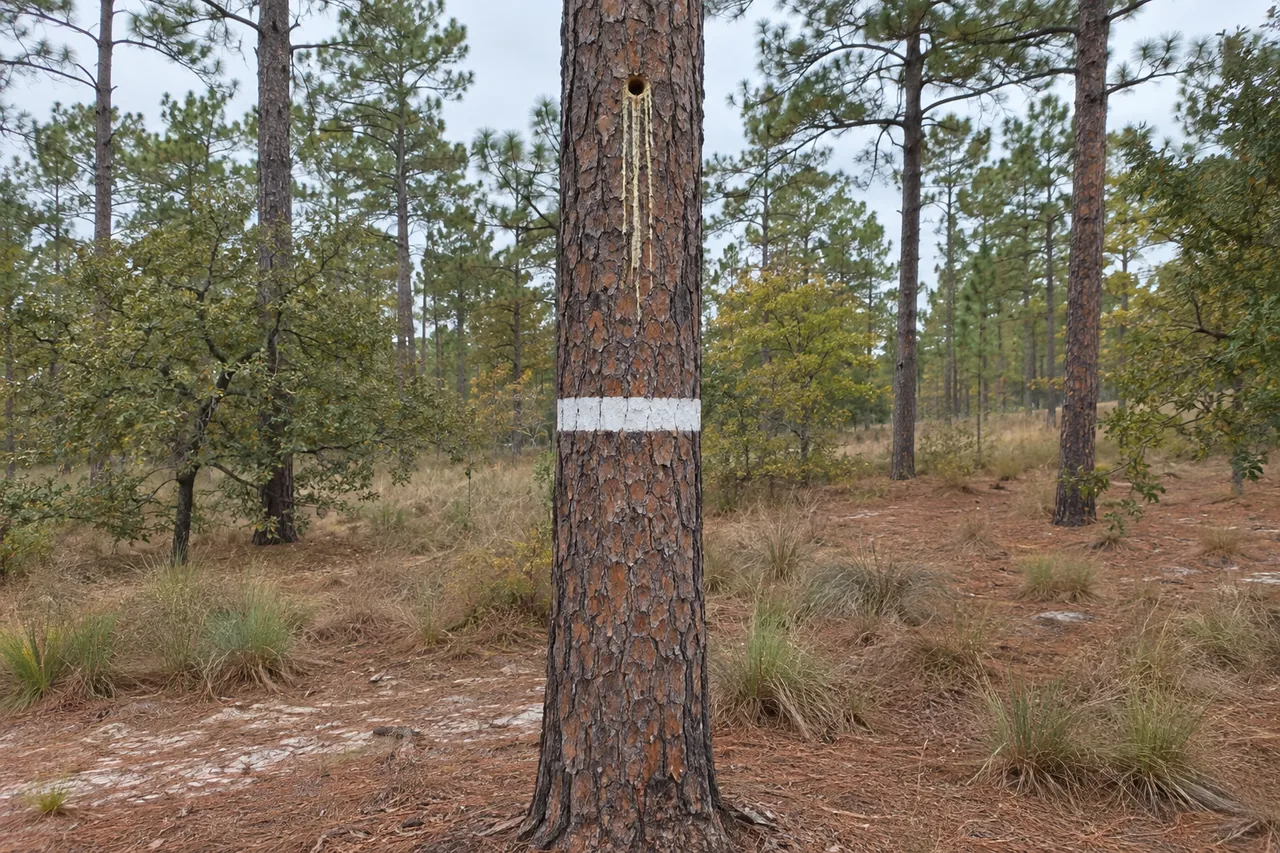
The red-cockaded woodpecker roosts and nests in cavities it builds in pine trees, and the U.S. Fish and Wildlife Service runs a project review process with color-coded maps for Moore County. The Service's Moore County project review page shows "red-cockaded woodpecker nesting trees identified with a white band of paint" (checked Nov 9, 2026). If a pine on or next to your lot has that band, stop and read this before anyone works near it.
The bird is federally protected. The Service reclassified it from endangered to threatened in a rule effective November 25, 2024. Threatened doesn't mean unprotected: the Service says the rule that came with it adopts the same prohibitions that apply to an endangered species, on both public and private lands (Federal Register, October 25, 2024, and the Service's reclassification Q&A; checked Nov 9, 2026). The exceptions the Q&A lists include prescribed burns and herbicide use on private land when the owner follows best management practices, trained people installing artificial cavities, work under a federal permit or conservation agreement, and some habitat work on public land. Taking down a yard tree isn't on that list.
Moore County has its own review process. The Service's Moore County page splits the county into a Red Zone and a Clear Zone on its maps, and if any part of a lot is in the Red Zone, the whole lot is treated as Red Zone (checked Nov 9, 2026):
- Red Zone: a cavity tree survey by a qualified environmental consultant is required when removing trees 8 inches or more across at breast height. The survey, a site plan and the Service's review request letter go to the Raleigh field office. The Service says it will strive to respond within 30 days, though it can take up to 60, and not to proceed until it responds.
- Clear Zone: no survey is required before tree removal. The project owner fills out and prints the Service's self-certification letter, keeps it, and emails a copy to the Service. The letter is good for one year and covers work that will not take place within 50 feet of a red-cockaded woodpecker cavity tree. If the birds dig a new cavity in a pine on the property during that year, the letter doesn't allow removing that tree or disturbing the ground under its branches. It also recommends keeping turpentine trees and all old-growth longleaf, and removing or trimming large branches as a first option instead of taking down a whole tree.
Why it matters. The bird has federal protection, and Section 11 of the Endangered Species Act provides both civil and criminal penalties for violations (checked Nov 9, 2026). The Service's Moore County page is plain about the order of things: in the Red Zone, don't proceed with work until the Service responds that it can go ahead.
The practical steps: check the Service's Moore County map before pine work, keep everyone well away from a marked tree, and email the Raleigh field office at raleigh@fws.gov or call (919) 856-4520 with questions (checked Nov 9, 2026). Tell the contractor about any marked tree when you send your request, and agree in writing who checks the map and signs any letter before work starts.
How a tall pine comes down near a house
A pine's straight trunk usually makes it simpler to take apart than a spreading oak, but its height means few lots have room to drop one whole.
- Felled whole only where there's an open lane longer than the tree is tall, toward a field, the woods or open ground the owner controls.
- Dismantled in sections, the usual method near a house. A climber or a bucket truck removes limbs on the way up, then the top and trunk come down in pieces, lowered on ropes or dropped onto a cleared landing spot.
- Lifted out by crane when the pine leans over the roof, is dead or lightning-damaged and unsafe to climb, or has nothing below it that can take a falling piece.
Pine logs are heavy and sticky with resin. Settle whether the trunk is hauled, chipped, or cut into rounds and left. Inside Southern Pines and Pinehurst, burning the brush isn't allowed, and the towns' curbside limits won't take a whole pine. If the pine has the service wire to your house running past it, Duke Energy says it will disconnect the drop for the work and reconnect it afterward without billing the customer; Central Electric and Randolph EMC members should call their co-op (checked Nov 9, 2026).
What pine removal costs
National cost guides do price pines separately (all checked Nov 9, 2026):
- HomeGuide: $200 to $1,600 for a pine, and $2,000 to $3,000 for one 100 feet or taller. Crane help adds $500 to $2,500 a day.
- HomeAdvisor (updated April 16, 2024): $200 to $1,500 or more, with a 40-foot pine around $400 and an 80-foot pine around $1,500.
- Angi: $250 to $1,500 for a pine.
Height, lean, what's underneath, access, whether a crane is needed, and what happens to the logs move a pine job up or down. Any Red Zone survey a consultant performs is a separate cost. See published prices; the contractor's written price for your pine is what counts.
Pine mistakes to avoid
- Ignoring a lightning strike because the pine is still green.
- Waiting for red needles. NC State Extension describes beetle-killed pines fading to red, so by then the tree is already dead.
- Scarring the pines you keep with equipment, spikes or a misplaced log.
- Cutting large anchoring roots for a driveway, fence or trench.
- Working near a banded pine without checking the Service's Moore County map and rules first.
- Topping a pine to shorten it. It doesn't make a tall pine safe.
Pine questions
Is a longleaf safer than a loblolly in a hurricane?
Less likely to snap, in the Katrina studies the Forest Service summarized, but more likely to lean or blow over whole. Judge each pine by its health, its lean, its distance from the house and what's been done to its roots.
Can a beetle-attacked pine be saved?
Not once its needles have turned red; NC State Extension describes pines killed by bark beetles fading from green to yellow to red. It also notes that a tree may survive a light black turpentine beetle attack, while heavy ones kill trees. The point of quick removal is usually to protect the healthy pines nearby.
Do I need anyone's permission to cut a pine on my lot?
Usually not from Southern Pines or Pinehurst for a tree on your own lot outside the right-of-way and, in Pinehurst, the historic district's front yards. The federal woodpecker rules are separate and apply anywhere in Moore County; check the Service's map before cutting.
How can I tell if a pine is a woodpecker cavity tree?
Marked cavity trees carry a white paint band. Unmarked ones aren't always obvious, which is why the Service calls for a consultant's survey in the Red Zone. If you're unsure about any pine, ask the Raleigh field office before work starts.
Your request goes to one independent contractor who works in Moore County. This site doesn't cut pines or handle federal paperwork.
- NC State Extension Plant Toolbox, Pinus palustris and Pinus taeda; Pine Bark Beetles (K. Oten, August 4, 2022). USDA Forest Service, Fire Effects Information System, Pinus palustris (Carey, 1992). Checked Nov 9, 2026.
- N.C. Forest Service, "Longleaf Pine is Resilient in the Face of Hurricane Winds," SRN-006 (July 14, 2017); Forest Health Note on southern pine beetle (June 2016); 2025 Forest Health Highlights. Checked Nov 9, 2026.
- Mississippi State University Extension, P2448. State Climate Office of North Carolina, January 2000 winter storm record and January 2026 "Rapid Reaction." NWS Raleigh, Florence post-tropical cyclone report (2018). Checked Nov 9, 2026.
- U.S. Fish and Wildlife Service: Federal Register reclassification rule (October 25, 2024); reclassification Q&A; Red-cockaded woodpecker project review, Moore County; Moore County Clear Zone letter (September 2025); Endangered Species Act Section 11. Checked Nov 9, 2026.
- HomeGuide, tree removal cost guide; HomeAdvisor, tree removal cost guide (updated April 16, 2024); Angi, tree removal cost guide. Duke Energy, Trees and Safety. Checked Nov 9, 2026.